
Reptiles
Corn Snake Care Guide
Corn snakes need a secure vivarium as long as the snake, an 82–86°F basking zone, 40–50% humidity and a thawed mouse every 1–2 weeks. Setup and pitfalls.
- corn snake
- snakes
- reptiles
- beginner friendly
- colubrid
Corn Snake at a glance
- Lifespan
- 10–15 years (record over 30)
- Size
- Medium
- Temperament
- Placid, active, a good climber
- Group
- Reptiles
Care level: Beginner
A good fit for first-time owners who read up before bringing one home.
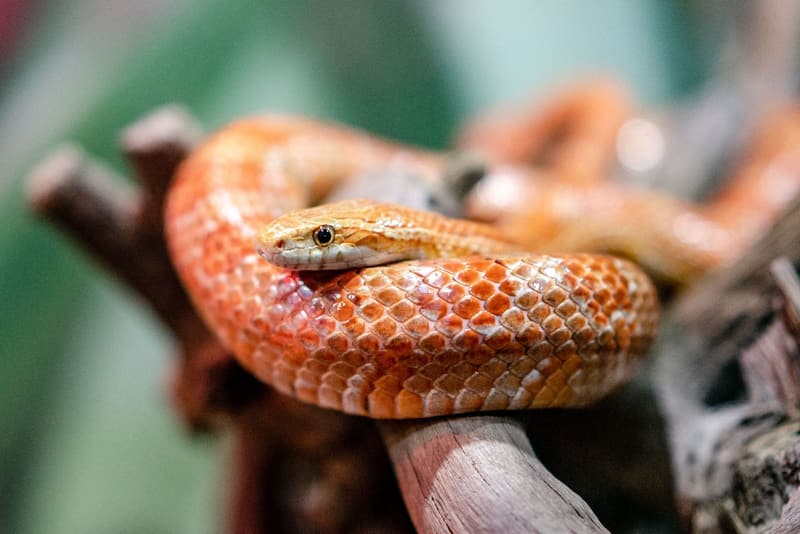
The corn snake (Pantherophis guttatus) is a slim, non-venomous American rat snake that usually measures 28–47 in (70–120 cm) as an adult, sometimes about 5 ft (150 cm), and is bred in a huge range of colour morphs. It is active at dawn and dusk, climbs well, can get used to regular handling, needs only moderate humidity and often no night heat, which makes it one of the more forgiving pet snakes. It suits a first-time snake keeper who will build a secure, well-furnished vivarium and feed thawed mice for 10 to 15 years or more.
Care requirements
| Need | What to provide |
|---|---|
| Enclosure | Length at least the snake’s length, width and height at least one-third of it: 60 × 20 × 20 in (150 × 50 × 50 cm) for a 5 ft snake. Secure, lockable doors (RSPCA) |
| Temperature | Basking zone 82–86°F (28–30°C), cool end 68–75°F (20–24°C), nights can fall to 61–68°F (16–20°C). Thermostat on every heat source (RSPCA) |
| Humidity | 40–50% (RSPCA); MSD gives a wider 30–70% range (RSPCA; MSD) |
| Lighting | Low-output 2–7% UVB tube at the warm end. UVI 1.0 at the basking spot down to 0 in shade, max 0.7 for albinos, 12 hours on, 12 off (RSPCA) |
| Diet | Frozen-thawed mice: a pinky every 5–6 days for hatchlings, up to one adult mouse every 7–14 days, slightly wider than the snake’s widest point (RSPCA) |
| Lifespan | Around 10–15 years (RSPCA); captive record just over 32 years (RSPCA; ADW) |
| Social needs | Alone. Solitary in the wild, and snakes housed together risk injury at feeding (RSPCA; MSD) |
| Legal notes | No common restrictions; check local rules. |
Corn snake vs ball python
These are the two snakes most often recommended to beginners, and they need different setups. For the python’s requirements, see the ball python care guide.
| Corn snake | Ball python | |
|---|---|---|
| Build and activity | Slender, active, climbs readily (RSPCA) | Heavy-bodied, shy, a partial basker (RSPCA) |
| Basking zone | 82–86°F (28–30°C) (RSPCA) | 86–90°F (30–32°C) (RSPCA) |
| Humidity | 40–50% (RSPCA) | 50–60%, misted to 80% (RSPCA) |
| Night heat | Often none needed in a heated home (RSPCA) | Always provide dark heat (RSPCA) |
| Typical adult prey | One adult mouse every 7–14 days (RSPCA) | Rodents sized to the snake, every 7–14 days by weight; known for going off food (RSPCA) |
| Lifespan | 10–15 years (RSPCA) | 20+ years (RSPCA) |
An escape-proof, enriched vivarium
The RSPCA notes that corn snakes prefer larger enclosures and are more active when given one, and that they choose enriched setups over bare ones. Give the snake room to stretch out fully, branches or peg boards to climb, and hides at ground level and above (for example, one fixed securely in the branches). Put at least one hide at each end so the snake never has to trade security for the right temperature, and a third with damp moss for shedding. Hides should be snug: the coiled snake’s body should touch the sides.
Hatchlings can be stressed in a big, open space. Start them in a small enclosure and move them up as they grow, or pack a larger one with small hiding spots (RSPCA).
For substrate, the RSPCA suggests organic reptile soil or a mix of about 60% soil, 30% sand and 10% dry, sterilised leaves. Use paper towels only for the first weeks, when you want to monitor droppings. The RSPCA stresses that the vivarium must be secure against escape, so check door fit, vents and cable holes before the snake goes in.
Heating without overdoing it
Corn snakes are a cooler-running species than pythons. Use a guarded heat lamp at one end, on a thermostat with the probe just above the substrate, set for an 82–86°F (28–30°C) basking zone. For a small hatchling enclosure, the RSPCA recommends a heat mat under one side, on an on/off thermostat set at 86°F (30°C). The MSD Veterinary Manual gives a preferred optimum temperature zone of 77–86°F (25–30°C) for corn and rat snakes, which matches.
In a normally heated home you can switch the heat off at night and let the vivarium fall to 61–68°F (16–20°C). Only add a ceramic heater or mat, again thermostat-controlled, if your room gets colder (RSPCA). Record both ends daily with digital thermometers.
Feeding
Feed dead prey with tongs inside the vivarium: frozen mice, thawed fully. Step prey size up as the snake grows, keeping it slightly wider than the widest part of the body. The RSPCA suggests an occasional quail or rat, roughly once a month, for variety. Weigh the snake regularly to catch it becoming underweight or obese. VCA’s general guidance (younger snakes about twice a week, mature snakes every week or two) fits the RSPCA schedule.
Gotchas
- Handling within 48 hours of a meal. The snake may regurgitate (RSPCA).
- Smelling of mouse. Wash your hands after handling prey, or the snake may strike at your hand (RSPCA).
- An S-shaped neck. A snake that pulls its head back into an S is feeling threatened. Leave it alone and try another time (RSPCA).
- Retained eye caps. Check every shed skin for both eye caps. If they stay on the snake, they need removing promptly (RSPCA).
- Blisters on the skin. These can mean the snake is being kept too damp (RSPCA).
Avoid
- Live prey. Even a small mouse bite can cause a severe, potentially life-threatening infection. Never leave prey in the vivarium for more than two hours (VCA)
- Any heat lamp or mat without a thermostat, and unguarded bulbs
- Sand on its own as substrate, which can irritate the skin (RSPCA)
- Housing two corn snakes together
- Handling during shed, or for longer than 10–15 minutes at a time (RSPCA)
Signs to see a vet
See a reptile vet for abnormal droppings, signs of mouth rot, mites, weight loss during a winter slowdown, or stuck shed that bathing in slightly warm water doesn’t loosen (RSPCA).
Care guides that cover corn snakes
Choosing Your First Pet
Eight common first pets compared on lifespan, daily time, space, handling, company and active hours, plus the questions to settle before you buy or adopt.
Cleaning Small Pet, Bird and Reptile Habitats
How often to spot-clean and deep-clean each small pet's home, which disinfectants are safe at what dilution and contact time, and why birds need extra care.
Exotic Pet Laws
Sourced restrictions that catch pet owners out, from California's ferret and gerbil ban to Queensland's rabbit ban, small turtles, Florida reptiles and CITES parrots.
Frequently asked questions
Are corn snakes venomous?
No. They kill prey by constriction (RSPCA). In the wild they are sometimes mistaken for venomous copperheads, but corn snakes have a narrower head, lighter colouring and squarer blotches (ADW).
How long do corn snakes live?
The RSPCA gives around 10–15 years. ADW records a captive corn snake that lived just over 32 years, so plan for the long end.
Is it normal for a corn snake to eat less in winter?
Some corn snakes brumate, eating less as daylight shortens. That is normal as long as they don't lose weight, so keep weighing them (RSPCA).
Why does my corn snake spend all day in its water bowl?
Long soaks can be a sign of snake mites, which feed on blood and spread disease. Look for tiny black specks on the snake and around the bowl (RSPCA).
Do corn snakes need vitamin supplements?
No. Whole, healthy prey is a complete diet for a snake, so supplements are unnecessary (RSPCA; VCA).
Sources
- RSPCA: How To Care For a Corn Snake
- VCA Animal Hospitals: Feeding Pet Snakes
- Animal Diversity Web: Pantherophis guttatus (Red corn snake)
- MSD Veterinary Manual: Management and Husbandry of Reptiles
- RSPCA: How To Care For a Royal Python
More reptiles

Ball Python
Ball pythons need an enclosure as long as the snake, 50–60% humidity, frozen-thawed rodents sized by body weight, and a thermostat on every heat source.
Read
Crested Gecko
Crested geckos need a tall vivarium, temperatures at or below about 82°F, misting that dries out between sprays, and a mix of fruit, gecko diet and insects.
Read
Leopard Gecko
Leopard geckos need a warm belly-heat basking zone of 82–86°F, dry air, low-level UVB, gut-loaded insects and a calcium dish. Setup, feeding and pitfalls.
Read