
Reptiles
Crested Gecko Care Guide
Crested geckos need a tall vivarium, temperatures at or below about 82°F, misting that dries out between sprays, and a mix of fruit, gecko diet and insects.
- crested gecko
- geckos
- reptiles
- arboreal
- beginner friendly
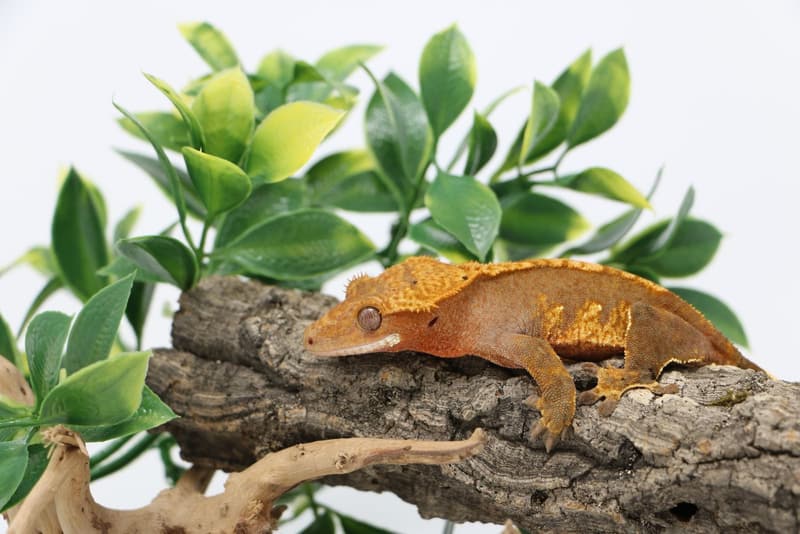
Crested Gecko at a glance
- Lifespan
- 15–20 years
- Size
- Small
- Temperament
- Calm but jumpy, tolerates gentle handling
- Group
- Reptiles
Care level: Beginner
A good fit for first-time owners who read up before bringing one home.
The crested gecko (Correlophus ciliatus, formerly Rhacodactylus ciliatus) is a tree-dwelling gecko from the humid forests of New Caledonia, thought extinct until 1994, that grows to about 8 in (20 cm) and can live 15 to 20 years. Its needs are close to the reverse of a desert lizard’s: a tall vivarium, mild temperatures, a humid misting cycle and a diet built partly on fruit and prepared gecko food. It suits keepers whose homes stay cool and who want a climber to watch at dusk rather than a basking lizard.
Care requirements
| Need | What to provide |
|---|---|
| Enclosure | Tall, minimum 18 × 24 × 18 in (45 × 60 × 45 cm, W × H × D) for one adult. Glass holds up better than wood in the humidity (RSPCA) |
| Temperature | Warmest spot only 79–82°F (26–28°C), cool zone 68–75°F (20–24°C), nights down to 64–68°F (18–20°C). Thermostat on any heater (RSPCA) |
| Humidity | 40–50% baseline, misted up to about 80%, then allowed to dry back. Substrate must not stay waterlogged (RSPCA) |
| Lighting | 5–7% UVB lamp at the top of the vivarium. UVI 0.7 in the basking zone down to 0 in the shade, 12 hours on, 12 off (RSPCA) |
| Diet | Mashed fruit with supplement, crested gecko diet (CGD) and live insects, rotated week by week (RSPCA) |
| Lifespan | Up to 15–20 years (RSPCA); ADW gives 10–20, possibly longer (RSPCA; ADW) |
| Social needs | Best kept alone. Never house males with others; females only with plenty of space and close watching (RSPCA) |
| Legal notes | No common restrictions; check local rules. |
Crested vs leopard gecko
New keepers often treat the two as interchangeable. They are not. If you want the ground-dwelling, heat-loving species, see the leopard gecko care guide.
| Crested gecko | Leopard gecko | |
|---|---|---|
| Lifestyle | Arboreal climber and jumper (RSPCA) | Ground-dwelling, hides under rocks (RSPCA) |
| Enclosure shape | Taller than it is long (RSPCA) | Longer than it is tall (RSPCA) |
| Warmest spot | 79–82°F (26–28°C) (RSPCA) | 82–86°F (28–30°C) (RSPCA) |
| Humidity | 40–50%, misted to 80% (RSPCA) | 30–40%, dry (RSPCA) |
| Diet | Fruit, CGD and insects (RSPCA) | Insects only (RSPCA) |
| Dropped tail | Does not grow back (RSPCA; ADW) | Grows back (RSPCA) |
Keeping it cool
Crested geckos do not need a hot basking spot. The RSPCA’s warmest recommended point is 82°F (28°C), below the basking range it gives for leopard geckos. A low-wattage, guarded lamp on a thermostat at the top of the vivarium is enough, and in a warm room you may barely need it. The bigger risk is overheating. Hobbyist guidance generally treats sustained temperatures above about 82°F as dangerous for this species. A vivarium near a sunny window, on top of a radiator or in a room without air conditioning in summer can pass that easily. Keep a digital thermometer at the top and another lower down, and check both daily.
At night, temperatures can safely drop to 64–68°F (18–20°C). If your room gets colder, use a non-light-emitting heater on a thermostat: a ceramic heater needs a dimming or pulse-proportional thermostat, and a heat mat needs an on/off one with the probe on the mat (RSPCA).
The misting cycle
Humidity matters most for shedding and for the sticky toe pads that let the gecko walk on glass. Aim for a 40–50% baseline, and mist with clean water to push it up to around 80%. Then let it fall back before the next misting (RSPCA). Many geckos drink the droplets, but always keep a water dish too. A vivarium that stays saturated breeds bacteria that cause skin and respiratory infections, so use substrate that holds moisture without pooling, such as coir or a soil mix topped with moss or leaves, and make sure there is good ventilation.
Furnish it vertically: fruit-tree or grapevine branches, vines, tall broad-leaved plants and cork-bark tubes or half coconut shells for daytime hiding (RSPCA). Climbing space is what prevents floppy tail.
Feeding: gecko diet, fruit and insects
Commercial crested gecko diet comes as a powder you mix with water. The RSPCA treats it as one part of the diet rather than the whole thing. Choose a brand without wheat, rice or bran, and remove leftovers daily because it sours. One rotation it suggests: a week of mashed fruit with supplement (blueberries, pear, papaya, strawberries, mango), then a week of live insects, then a week of CGD.
Insects such as small dubia roaches, calciworms and crickets should be gut-loaded for 24–48 hours and dusted lightly just before feeding. Feeding them in a separate tub stops the gecko swallowing substrate. Weigh the gecko regularly to confirm steady growth (RSPCA).
Gotchas
- Grabbing the tail. Crested geckos drop their tails to escape predators, and the tail does not grow back. Losing it costs fat reserves and agility (RSPCA; ADW). Let the gecko walk onto your hand.
- Short climbing space. A short or bare vivarium leads to floppy tail syndrome (RSPCA).
- Toe pads losing grip. This usually points to low humidity or a nutritional deficiency (RSPCA).
- Stuck shed on toes. Retained skin can cost the gecko its toes. Soak it in shallow, tepid water and rub the skin off gently (RSPCA).
- Long handling sessions. Keep them to about 10 minutes so the gecko’s core temperature doesn’t drop. Expect it to jump (RSPCA).
Avoid
- Citrus fruits and banana, which interfere with calcium uptake (RSPCA)
- Gecko diets containing wheat, rice or bran (RSPCA)
- Any heater without a thermostat, and vivariums in direct sun
- Waterlogged substrate
- Crickets left in overnight, which bite sleeping geckos (RSPCA)
- Housing males together
Care guides that cover crested geckos
Cleaning Small Pet, Bird and Reptile Habitats
How often to spot-clean and deep-clean each small pet's home, which disinfectants are safe at what dilution and contact time, and why birds need extra care.
Multi-Pet Households
Which rabbits, guinea pigs, rodents, ferrets, birds and reptiles can share housing, which must never meet, and the diseases that cross species.
Pet Emergency Preparedness
Per-species go-kits, keeping tanks and heat lamps going in a power cut, a pet-sitter sheet and ID records for floods, storms and evacuations.
Frequently asked questions
Are pet crested geckos wild-caught?
No. They were believed extinct for more than a century until a population was found in New Caledonia in 1994, and the RSPCA says all crested geckos kept in the UK are now captive bred (RSPCA; ADW).
What does it mean when a crested gecko "fires up"?
Crested geckos can change colour, and keepers call the darker phase firing up. It is a normal colour change, not a sign of illness on its own (RSPCA).
Why is my crested gecko's tail bending over?
That is floppy tail syndrome. The RSPCA links it to too little climbing space, which leaves the gecko sleeping head-down on the glass until the tail bends and can be damaged.
How big is an adult crested gecko?
About 8 in (20 cm) including the tail. ADW gives an average total length of 20.3 cm and an adult weight of about 30–35 g (1–1.2 oz).
Can I keep two crested geckos together?
Never keep males with other geckos permanently. Females may share if each has its own basking, hiding and feeding areas, but separate them at once if you see chasing, squeaking, tail shaking or biting (RSPCA).
Sources
- RSPCA: Caring for your Crested Gecko
- Animal Diversity Web: Rhacodactylus ciliatus (Crested Gecko, Eyelash Gecko)
- RSPCA: How To Care For a Leopard Gecko
More reptiles
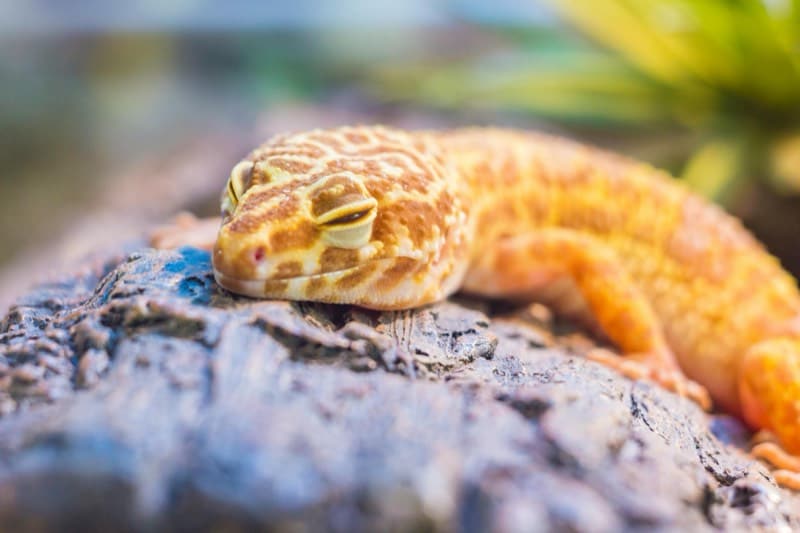
Leopard Gecko
Leopard geckos need a warm belly-heat basking zone of 82–86°F, dry air, low-level UVB, gut-loaded insects and a calcium dish. Setup, feeding and pitfalls.
Read
Ball Python
Ball pythons need an enclosure as long as the snake, 50–60% humidity, frozen-thawed rodents sized by body weight, and a thermostat on every heat source.
Read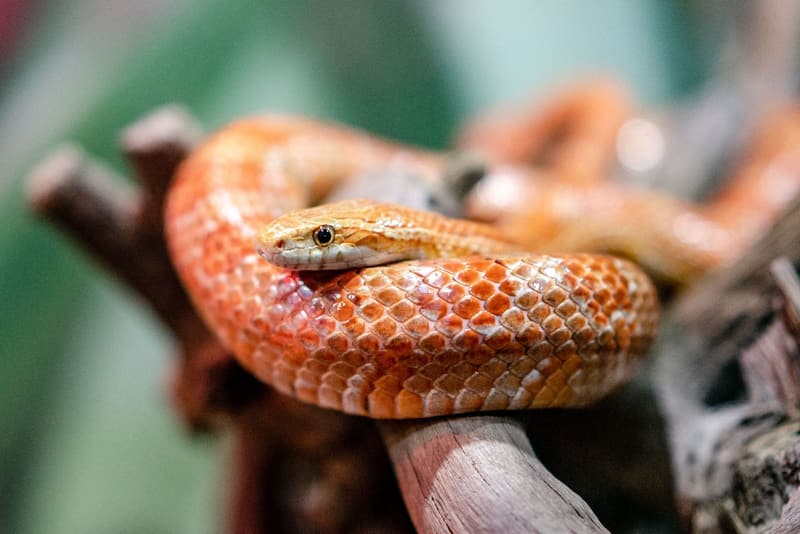
Corn Snake
Corn snakes need a secure vivarium as long as the snake, an 82–86°F basking zone, 40–50% humidity and a thawed mouse every 1–2 weeks. Setup and pitfalls.
Read